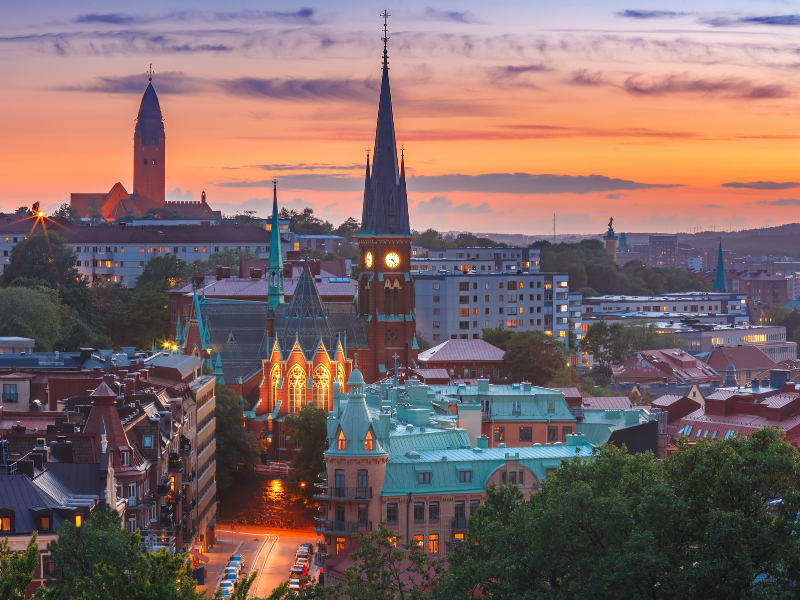
Sweden is not the first country most Nepali students think of when planning to study abroad
But it arguably should be. It consistently ranks among the top countries in the world for quality of life, innovation, and research output. Its universities are globally respected, the teaching style is collaborative and independent, and there is a structured post-study pathway for international graduates. Here is everything you need to know.
Why Consider Sweden?
- Home to world-class universities including Uppsala University, Lund University, KTH Royal Institute of Technology, and Stockholm University
- Education is research-driven and highly practical — Swedish universities are known for producing graduates who can think independently
- Approximately 1,000 master’s programs are taught entirely in English — a wide range for international students
- High quality of life — Sweden consistently ranks in the top 5 globally for safety, work-life balance, and healthcare
- Post-study job-seeking permit available after graduation
- No restriction on working hours during studies
- Growing demand for skilled graduates in IT, engineering, sustainability, and healthcare — sectors where Sweden is a global leader
Visa — The Swedish Residence Permit for Studies
Sweden does not issue a traditional student visa. Instead, Nepali students apply for a Residence Permit for Studies through the Swedish Migration Agency (Migrationsverket). This permit is required for any course lasting more than 3 months.
Key Requirements
- Full admission to a full-time program at a recognised Swedish university — distance learning does not qualify
- Tuition fees paid in full (or first instalment) before applying — the university notifies Migrationsverket once payment is confirmed
- Proof of sufficient funds to support yourself throughout your stay
- Comprehensive health insurance — required if your program is less than 1 year in duration
- Valid passport for the duration of your studies
Permit Fees
| Fee Item | Amount (2026) |
|---|---|
| Residence permit application fee | SEK 1,500 |
Financial Requirements — 2026 Official Figures
These figures come directly from the Swedish Migration Agency (Migrationsverket) for applications submitted in 2026:
| Requirement | Amount (2026) |
|---|---|
| Minimum monthly living cost | SEK 10,656 per month (approx. NPR 130,000) |
| Reduction if free housing is provided by institution | SEK 4,736 less per month |
| Reduction if free food is provided by institution | SEK 2,960 less per month |
| Funds must cover | The full duration of the period you are applying for |
You must demonstrate that you have access to these funds through your own bank savings, a scholarship, student loans from Nepal, a sponsor, or income from employment. A combination of sources is accepted.
Important: Pay Tuition Before Applying for Your Permit
Unlike the UK or Canada, Sweden requires you to pay your tuition fee (or first instalment) before your university will notify the Migration Agency — and the Migration Agency will not process your permit until they receive this notification.
Apply for your residence permit as soon as your university confirms your tuition payment. Processing takes approximately 2 to 3 months — do not delay.
Tuition Fees for Nepali Students
Sweden offers tuition-free education for EU/EEA citizens, but Nepali students pay full international tuition fees. Here is the typical range:
| Program Level / Field | Annual Tuition Fee Range (Average) |
|---|---|
| Bachelor’s programs — most subjects | SEK 90,000 to SEK 130,000 |
| Master’s programs — arts, business, social sciences | SEK 80,000 to SEK 140,000 |
| Master’s programs — STEM and engineering | SEK 130,000 to SEK 200,000 |
| Medicine and healthcare programs | SEK 150,000 to SEK 250,000+ |
Swedish tuition is higher than some European alternatives — but competitive with UK and Canadian fees, especially when combined with scholarship opportunities.
Scholarships — Real Opportunities for Nepali Students
Sweden has some of the most generous scholarship programs available to international students. These are competitive but genuinely accessible for strong candidates.
| Scholarship | What It Covers |
|---|---|
| Swedish Institute Scholarships for Global Professionals (SISGP) | Full tuition + SEK 12,000 per month living allowance + travel grant + insurance — highly competitive |
| Lund University Global Scholarship | Partial to full tuition reduction — merit-based for master’s programs |
| Uppsala University scholarships | Tuition reduction of 25% to 100% for master’s programs |
| KTH Royal Institute scholarships | Tuition reduction for select programs — merit-based |
| Erasmus Mundus Scholarships | Full funding for joint European master’s programs — very prestigious |
Scholarship Application Tip
Most Swedish university scholarships open in February or March for the autumn intake. Apply to your program on universityadmissions.se first — then check each university’s scholarship portal for deadlines. The Swedish Institute scholarship has an earlier separate deadline — usually in February.
Scholarships are awarded to those already admitted, so apply for admission early.
English Language Requirements
| Program Level | Typical IELTS Requirement |
|---|---|
| Bachelor’s programs | IELTS 6.5 overall — no individual band below 5.5 |
| Master’s programs | IELTS 6.5 to 7.0 — no individual band below 6.0 |
IELTS is the most commonly required test for Swedish universities. PTE Academic is accepted by some institutions but is not universally recognised in Sweden. Confirm your specific program’s requirements before booking your test.
Processing Time for the Residence Permit
- Expect 2 to 3 months or longer
- The Swedish Migration Agency is transparent that processing times vary and can exceed 3 months during peak periods.
- Apply online through migrationsverket.se as early as possible after your tuition payment is confirmed.
- For an August/September intake: pay tuition in April, apply for your permit in April or May at the latest.
- A paper application takes considerably longer than an online application — always apply online.
Work Rights During and After Studies
During Studies
- International students in Sweden can work without any restriction on hours. There is no 20-hour or 24-hour cap. This is a significant advantage for students who want to earn while studying.
- You must obtain a Personal Identity Number (Personnummer) to work legally in Sweden — this is issued after arrival and registration with the Swedish Tax Agency
- Your study course must be longer than 13 months to be eligible for a Personnummer
After Graduation — Post-Study Pathway
- After completing your degree, you can apply for a 12-month job-seeking residence permit to find employment in Sweden. If you secure a job that meets the salary and qualification requirements, you can then apply for a work permit.
- Job-seeking permit: 12 months to find qualifying employment — cannot be extended under the same category
- Swedish work permit requires a job offer with a salary that meets Swedish collective agreement levels
- Sweden’s strong sectors for international graduates: IT, engineering, life sciences, sustainability, and finance
Step-by-Step — How to Apply from Nepal
⚠️ Important: There Is No Swedish Embassy in Nepal
Sweden does not have an embassy in Kathmandu. The Embassy of Sweden in New Delhi, India handles all residence permit matters for Nepali nationals.
This means you will need to travel to New Delhi at least once — for biometrics and passport verification.
Plan your Indian visa and travel to New Delhi well in advance. Budget for flights and accommodation.
Step
| Action — and When to Do It |
|---|
| Step 1 — Apply on universityadmissions.se (6 months before intake) Submit your applications through Sweden’s national portal. Application fee: SEK 900 for non-EU students. Deadline is typically mid-January for the autumn intake. |
| Step 2 — Receive admission decision (March/April) Decisions for the first round come out in late March. Accept your offer through universityadmissions.se. |
| Step 3 — Pay first tuition instalment Pay as soon as possible after accepting your offer. Your university notifies Migrationsverket once payment is confirmed — you cannot apply for your permit until this step is complete. |
| Step 4 — Apply online for Residence Permit at migrationsverket.se Apply online. Attach your admission letter, proof of tuition payment, financial proof, passport copy, and health insurance if applicable. Pay the SEK 1,500 application fee online. |
| Step 5 — Travel to New Delhi for biometrics and passport check Once the Migration Agency contacts you, visit the Embassy of Sweden in New Delhi. No prior appointment is needed — walk in during migration section opening hours (Monday to Friday, 08:30 to 10:30 IST). Arrive early as queues can be long. Bring your original passport. At this visit, also pay the courier charge if you want your permit card sent to Nepal (see Step 7). |
| Step 6 — Wait for the Migration Agency decision Processing typically takes 2 to 3 months. Track your application status on migrationsverket.se. |
| Step 7 — Collect your Residence Permit Card Option A: Travel back to New Delhi to collect the card in person from the Embassy. Option B: If you paid the courier charge during your Step 5 visit, the card will be sent to a Swedish consulate in Nepal — collect it there in person. Representation collection is not allowed; you must collect in person. |
| Step 8 — Travel to Sweden Carry your residence permit card and all documents when you travel. Register your address in Sweden promptly after arrival to receive your Personnummer — required for work, banking, and healthcare. |
Have Questions? Let’s Talk.
Our counsellors will guide you through test preparation, course selection, and your full visa application.
Your future is worth getting right. Let us help you get there.